What Is Maghribi Abjad?
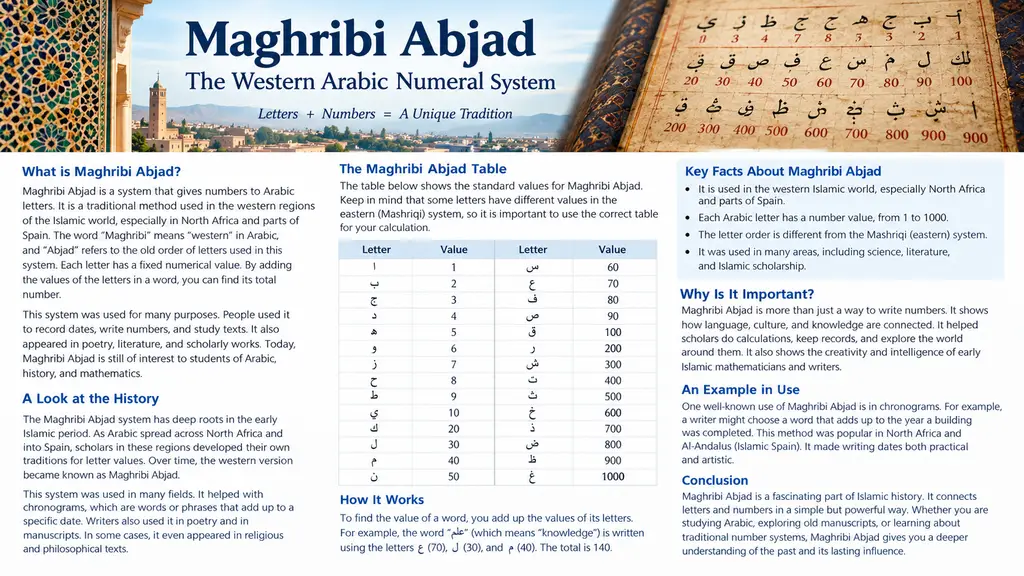
Maghribi Abjad is a traditional letter-number system. It gives each of the 28 Arabic letters a numerical value. The system follows an old letter order rather than the order most students learn today.
For example, Alif (ا) has a value of 1, Ba (ب) has a value of 2, and Jim (ج) has a value of 3. Larger values include 20, 50, 100, and 1,000. To find the value of a word, you add the values of its letters.
The main difference between Maghribi and Mashriqi Abjad appears in six letters. These differences can change the total value of a word, so choosing the correct system matters when studying historical texts or using an Abjad calculator. .
A Brief History of Maghribi Abjad
The Abjad system has roots in older Semitic writing traditions. Arabic scholars adopted letter-number values as Arabic became a major language of learning, literature, government, and religious study.
The Maghribi tradition developed in the western Islamic world. This included North Africa and al-Andalus, the name used for parts of the Iberian Peninsula under Muslim rule. Areas such as Morocco, Algeria, Tunisia, and historical Muslim Spain became important centers of Arabic scholarship and writing.
Books and manuscripts played a major role in preserving knowledge across these regions. Scholars copied religious texts, studied language, wrote poetry, and recorded information. Letter-number systems offered another way to represent numbers within written material.
One use of Abjad values was the chronogram. A chronogram is a word or phrase whose letter values add up to a particular year. A writer could use this method to mark the date of a building, an important event, or the death of a respected person.
The use of Abjad varied by place and period. Not every writer used it for the same purpose, and not every manuscript followed identical rules. Researchers must study the source itself to understand how its numbers were meant to work.
The Maghribi Abjad Letter-Value Table
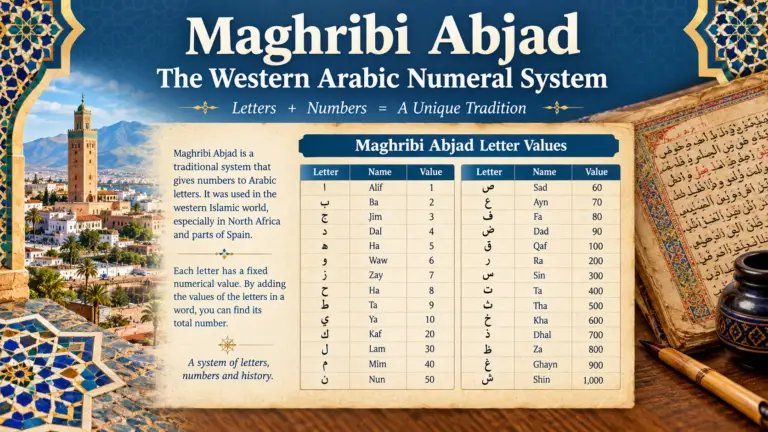
The following table shows the commonly cited Maghribi values. The first 14 letters have the same values as in the Mashriqi system. The main differences begin with the letters used for values above 50.
| Arabic letter | Name | Value |
|---|---|---|
| ا | Alif | 1 |
| ب | Ba | 2 |
| ج | Jim | 3 |
| د | Dal | 4 |
| ه | Ha | 5 |
| و | Waw | 6 |
| ز | Zay | 7 |
| ح | Ha | 8 |
| ط | Ta | 9 |
| ي | Ya | 10 |
| ك | Kaf | 20 |
| ل | Lam | 30 |
| م | Mim | 40 |
| ن | Nun | 50 |
| ص | Sad | 60 |
| ع | Ayn | 70 |
| ف | Fa | 80 |
| ض | Dad | 90 |
| ق | Qaf | 100 |
| ر | Ra | 200 |
| س | Sin | 300 |
| ت | Ta | 400 |
| ث | Tha | 500 |
| خ | Kha | 600 |
| ذ | Dhal | 700 |
| ظ | Za | 800 |
| غ | Ghayn | 900 |
| ش | Shin | 1,000 |
Important: Some sources use different transliterations for Arabic letter names. The Arabic letter is the clearest way to identify each character. Historical sources may also follow local conventions, so check the table used by your reference or calculator before making a calculation. The Maghribi values above reflect a commonly cited western variant. .
How to Calculate a Maghribi Abjad Value
Calculating a word’s value is straightforward. First, write the word correctly in Arabic. Next, find each letter in the Maghribi table. Finally, add the values together.
For example, consider the Arabic word علم (ilm), which means “knowledge.”
Its letters have these values:
- ع (Ayn) = 70
- ل (Lam) = 30
- م (Mim) = 40
Add the three numbers:
70 + 30 + 40 = 140
The Maghribi Abjad value of علم is 140 under this table.
This word also has a value of 140 in the commonly used Mashriqi system because none of its letters belong to the six that differ between the two traditions.
For a word that includes one of the six different letters, the result may change. This is why the system used for a calculation should always be clear.
Maghribi Abjad vs. Mashriqi Abjad
Maghribi and Mashriqi Abjad use the same basic method. Both assign numbers to Arabic letters, and both allow users to calculate the value of a word by adding those numbers.
Their main difference is the placement of six letters in the traditional sequence.
| Letter | Mashriqi value | Maghribi value |
|---|---|---|
| س (Sin) | 60 | 300 |
| ص (Sad) | 90 | 60 |
| ش (Shin) | 300 | 1,000 |
| ض (Dad) | 800 | 90 |
| ظ (Za) | 900 | 800 |
| غ (Ghayn) | 1,000 | 900 |
The other 22 letters keep the same values in these commonly used tables.
These differences are important when comparing results from online calculators, books, or historical sources. If a calculator uses Mashriqi values but a manuscript follows Maghribi values, some words will produce different totals.
Neither system should be applied automatically to every historical text. The correct choice depends on the source, region, and convention being studied.
Why Was Maghribi Abjad Used?
Maghribi Abjad had several uses in writing and scholarship.
Recording dates: Writers could use letter values to form chronograms. These phrases provided a memorable way to mark a year or event.
Studying manuscripts: Researchers can examine numerical references in old documents and compare them with the letter values used in a particular region.
Poetry and literature: Some writers used letter values as part of literary design. A word or phrase could carry both its ordinary meaning and a numerical value.
Organizing information: Letter-based number systems could serve as a way to mark, number, or arrange parts of a written work.
Preserving cultural history: Learning about regional letter values helps readers understand the differences between traditions across the Islamic world.
These uses did not mean that every word had a hidden meaning. A numerical total can be calculated from any word, but that fact alone does not prove that a writer intended a special message. Historical claims require evidence from the text and its context.
How to Use a Maghribi Abjad Calculator
An online Abjad calculator can make calculations faster, especially when a word contains many letters. However, not every calculator supports the Maghribi system.
Before using one, check the following points:
- Select the Maghribi system. Do not assume the calculator uses western values by default.
- Enter the Arabic spelling carefully. A missing dot or a different letter can change the result.
- Check how special characters are handled. Hamza, alif forms, and tāʾ marbūṭa may be treated differently by different tools.
- Review the letter-by-letter breakdown. A calculator that shows each letter’s value is easier to check than one that only displays a total.
- Compare the result with a trusted table. This is especially important when studying historical documents.
For learning, calculate a short word by hand before using a tool. This helps you understand the method and makes mistakes easier to find.
Common Mistakes to Avoid
One common mistake is confusing Maghribi Abjad with the modern Arabic alphabet order. The usual alphabet order groups letters in a way that helps students read and write. The traditional Abjad order assigns values according to a different sequence.
Another mistake is using the wrong regional table. A word containing Sin, Sad, Shin, Dad, Za, or Ghayn may have a different total under Maghribi and Mashriqi rules.
Spelling is also important. Arabic words can appear with different written forms, and calculators may handle certain characters differently. If you are studying a historical manuscript, preserve the original spelling when possible and explain any changes made for calculation.
Finally, do not confuse a numerical result with proof of a prediction or claim about the future. Abjad is a historical letter-number system. Any interpretation beyond the arithmetic needs its own evidence.
Frequently Asked Questions
What does Maghribi mean?
Maghribi means “western” in Arabic. In the context of Abjad, it refers to the western tradition associated with North Africa and al-Andalus.
How many letters are used in Maghribi Abjad?
The standard system uses 28 Arabic letters. Each letter has a numerical value, ranging from 1 to 1,000.
What is the highest value in Maghribi Abjad?
In the commonly cited Maghribi table, Shin (ش) has the highest value: 1,000.
Is Maghribi Abjad different from Mashriqi Abjad?
Yes. Both systems use letter values, but six letters have different numerical values in the commonly used tables. This can affect the total for some words.
Can I calculate English words using Maghribi Abjad?
The traditional system assigns values to Arabic letters. English words do not have standard Maghribi Abjad values unless someone first creates a separate method for mapping English letters to Arabic letters. Such a result would depend on that chosen method.
Is Maghribi Abjad still useful today?
Yes. It can help students, historians, language researchers, and readers explore manuscripts, chronograms, and the history of Arabic writing. Online tools also make it easier to learn the calculation method.
Conclusion
Maghribi Abjad is an important part of the history of Arabic writing and scholarship in the western Islamic world. It connects letters with numbers and shows how writers used language in practical, literary, and historical ways.
The calculation method is simple: identify each letter, look up its value in the Maghribi table, and add the values together. The challenge is choosing the correct table and spelling, especially when comparing results from different regions.
By learning the Maghribi values and understanding how they differ from Mashriqi Abjad, readers can study historical texts more carefully and avoid common calculation errors. The system offers a clear example of how letters can serve purposes beyond writing words.

Founder, Author & Educational Tool Developer
Shakeel Muzaffar founded AbjadCalculator.com and developed its calculation tools, Unicode handling, testing, and methodology. His work makes traditional Abjad letter-value systems easier to calculate and understand for educational and research purposes.