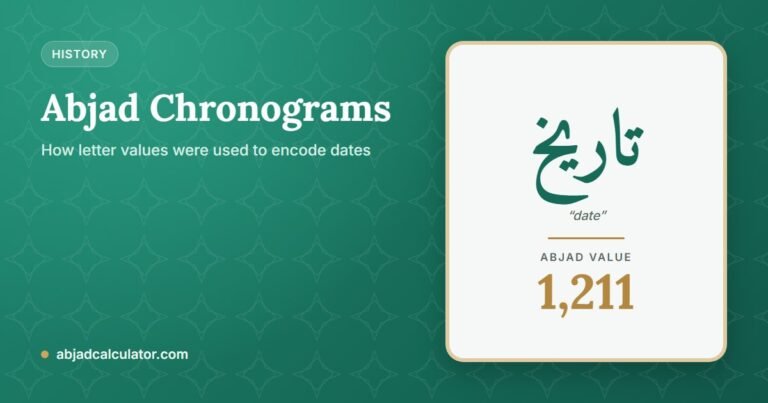
An Abjad chronogram is a word, phrase, poetic line, or inscription whose Arabic letters add up to a date. The date is not written directly as digits. Instead, it is hidden inside the numerical values of the letters.
Chronograms are one of the most interesting historical uses of Abjad numerals. They appear in Arabic, Persian, Ottoman, and wider Islamic literary and inscriptional traditions. They were used to record events such as construction dates, deaths, book completions, restorations, and other important moments.
This guide explains what Abjad chronograms are, how they work, where they appear, how to calculate them, and how to avoid common mistakes when reading them.
For the full letter-value system, read the Abjad Numerals Reference Encyclopedia. For the complete letter table, use the Abjad table. To calculate a phrase, use the Abjad calculator.
Quick Answer: What Is an Abjad Chronogram?
An Abjad chronogram is a date encoded through Arabic letter values.
A phrase is written so that the numerical values of its letters equal a year.
For example, the process works like this:
| Step | Action |
|---|---|
| 1 | Write the Arabic word or phrase |
| 2 | Assign each letter its Abjad value |
| 3 | Add the values together |
| 4 | Compare the total with a historical date |
| 5 | Check whether the date is Hijri, Gregorian, or another calendar system |
A chronogram is not just any Abjad calculation. It becomes a chronogram when the total is intentionally connected to a date.
Abjad Chronogram Meaning
The word chronogram means a written expression that contains a date. In Abjad chronograms, the date is hidden through the numerical value of Arabic letters.
In Persian literary terminology, chronograms are often connected with terms such as mādda-ye tārīkh, meaning the material or phrase of the date. In Arabic and Persian contexts, the word tārīkh can refer to both history and date.
A chronogram can be:
| Form | Description |
|---|---|
| One word | A single meaningful word that equals a date |
| Short phrase | A phrase chosen for its numerical total |
| Poetic hemistich | Half-line of poetry containing the date |
| Full verse | A complete poetic line encoding the year |
| Building inscription | A carved phrase or poem on architecture |
| Manuscript note | A completion, ownership, or event note |
The main idea is simple: the letters create both meaning and number.
How Abjad Chronograms Work
Abjad chronograms use the same basic letter values as other Abjad calculations.
In the common Mashriqi system:
| Letter | Value |
|---|---|
| ا | 1 |
| ب | 2 |
| ج | 3 |
| د | 4 |
| ه | 5 |
| و | 6 |
| ز | 7 |
| ح | 8 |
| ط | 9 |
| ي | 10 |
| ك | 20 |
| ل | 30 |
| م | 40 |
| ن | 50 |
| س | 60 |
| ع | 70 |
| ف | 80 |
| ص | 90 |
| ق | 100 |
| ر | 200 |
| ش | 300 |
| ت | 400 |
| ث | 500 |
| خ | 600 |
| ذ | 700 |
| ض | 800 |
| ظ | 900 |
| غ | 1000 |
For a full table with letter names and values, see the Abjad table.
To read a chronogram, the letters are added together. If the total matches a date connected to the event, the phrase may be functioning as a chronogram.
Simple Calculation Example
This is a basic Abjad calculation example, not a historical chronogram.
ابجد
| Letter | Value |
|---|---|
| ا | 1 |
| ب | 2 |
| ج | 3 |
| د | 4 |
| Total | 10 |
The total is 10.
A real chronogram usually uses a longer phrase that equals a meaningful year, such as a Hijri year connected to a death, building, restoration, or book completion.
What Makes a Phrase a Chronogram?
Not every Abjad total is a chronogram.
A phrase becomes a chronogram when there is evidence that the total was intended to mark a date.
| Ordinary Abjad Calculation | Abjad Chronogram |
|---|---|
| Calculates any word or name | Encodes a date |
| May have no historical context | Connected to a specific event |
| Used for value lookup | Used for dating |
| Can be random | Usually intentional |
| May be modern | Often found in texts, poetry, or inscriptions |
For example, calculating a name is not automatically a chronogram. It becomes one only if the text or inscription shows that the calculated total was meant to represent a year.
Where Abjad Chronograms Appear
Abjad chronograms can appear in several historical settings.
| Setting | Possible Use |
|---|---|
| Architecture | Construction or restoration date |
| Inscriptions | Event date carved into stone, wood, tile, or plaster |
| Poetry | Date hidden in a poetic phrase |
| Manuscripts | Completion date, ownership note, or event record |
| Tombs and memorials | Death date or memorial date |
| Books | Publication, copying, or completion date |
| Court culture | Praise poems and royal events |
| Religious buildings | Mosque, madrasa, shrine, or fort inscriptions |
The exact meaning depends on the source. A phrase on a building may relate to construction. A phrase in a manuscript colophon may relate to copying or completion.
Abjad Chronograms in Architecture
Architecture is one of the clearest places to find Abjad chronograms.
A building inscription may include a poetic phrase. The phrase may praise the founder, describe the building, or mention the purpose of the structure. At the same time, the letters of the phrase may add up to the construction year.
This means the inscription works on two levels:
| Level | Function |
|---|---|
| Literary meaning | The phrase has readable meaning |
| Numerical meaning | The letters encode a date |
This dual purpose is what makes chronograms valuable for historians and epigraphers.
A date hidden inside a building inscription can help identify when a fort, mosque, tomb, gate, school, or restoration project was completed.
Abjad Chronograms in Poetry
Chronograms also appear in poetry.
In poetry, the challenge is greater because the phrase must do two things:
- Fit the poetic meaning.
- Add up to the intended date.
A successful chronogram is not just mathematically correct. It also needs to sound natural within the poem.
This is why chronograms were often treated as a literary skill. The poet had to create a phrase that carried meaning, rhythm, and numerical accuracy at the same time.
Abjad Chronograms in Manuscripts
Chronograms may also appear in manuscripts.
They can occur in:
| Manuscript Location | Possible Meaning |
|---|---|
| Colophon | Date of copying or completion |
| Ownership note | Date of ownership transfer |
| Dedication | Date connected to patron or recipient |
| Marginal note | Later event or reading note |
| End page | Completion, death, or restoration note |
For manuscript numbering and foliation, see Abjad numerals in manuscripts. That page focuses on folio numbers and quire marks. This page focuses only on date-encoding chronograms.
Chronograms and Hijri Dates
Many Islamic chronograms encode Hijri dates.
The Hijri calendar is lunar, so a Hijri year does not match a Gregorian year exactly. When a chronogram total gives a number such as 950, 1102, or 1275, the first question is whether the date is Hijri.
A proper reading should ask:
| Question | Why It Matters |
|---|---|
| Is the date Hijri? | Most Islamic chronograms use Hijri years |
| Is the date Gregorian? | Some later inscriptions may use other calendars |
| Is another calendar involved? | Regional traditions may differ |
| Does the event fit the date? | Historical context must support the calculation |
| Is the phrase complete? | Missing letters can change the total |
Never assume the calendar without checking the historical context.
Chronograms and Mashriqi vs Maghribi Abjad
The choice of Abjad system can change the date.
The main difference is between:
| System | Common Context |
|---|---|
| Mashriqi Abjad | Eastern Arabic, Persian, Ottoman, Urdu, and many general Islamic contexts |
| Maghribi Abjad | North African and Andalusian contexts |
Six letters differ between the two systems:
| Letter | Mashriqi Value | Maghribi Value |
|---|---|---|
| س | 60 | 300 |
| ص | 90 | 60 |
| ش | 300 | 1000 |
| ض | 800 | 90 |
| ظ | 900 | 800 |
| غ | 1000 | 900 |
If a chronogram contains any of these letters, the final date may change depending on the system used.
For this reason, chronogram research should always identify the likely region, period, and Abjad system before accepting the result.
How to Calculate an Abjad Chronogram
Use this step-by-step method:
- Copy the Arabic phrase exactly.
- Confirm the letters from the original source.
- Remove punctuation and decorative marks.
- Decide whether to count diacritics, shadda, hamza, and ta marbuta according to your method.
- Choose Mashriqi or Maghribi values.
- Add the value of each letter.
- Compare the total with the event date.
- Check whether the date is Hijri, Gregorian, or another calendar.
- Verify the result against the inscription, manuscript, catalog, or scholarly source.
For special character rules, use Abjad calculation rules. For site-wide assumptions, see the methodology page.
Chronogram Calculation Template
Use this table when documenting a chronogram.
| Field | What to Record |
|---|---|
| Source | Manuscript, inscription, book, or building |
| Location | Where the phrase appears |
| Arabic phrase | Exact spelling |
| Transliteration | Optional reading aid |
| Translation | Meaning of the phrase |
| Abjad system | Mashriqi or Maghribi |
| Letter breakdown | Each letter and value |
| Total | Final calculated number |
| Calendar | Hijri, Gregorian, or other |
| Event | Construction, death, completion, restoration, etc. |
| Evidence level | Certain, likely, uncertain |
| Notes | Damage, spelling variants, missing letters, later edits |
This structure makes the result easier for other readers to verify.
Common Chronogram Mistakes
Chronograms are easy to misread. Small errors can change the final date.
| Mistake | Why It Matters |
|---|---|
| Wrong spelling | One changed letter can alter the total |
| Wrong Abjad system | Mashriqi and Maghribi values may differ |
| Damaged inscription | Missing letters can produce the wrong date |
| Later restoration | The visible text may not be original |
| Misread dots | Arabic letters can look similar |
| Ignoring ta marbuta | ة may be treated differently |
| Mishandling hamza | Hamza rules vary |
| Counting decoration | Ornamental marks are not letters |
| Wrong calendar | Hijri and Gregorian years differ |
| No historical context | A matching number alone is not proof |
A chronogram should not be accepted only because the calculation produces an interesting number. It needs textual and historical support.
How Historians Verify Chronograms
A serious chronogram reading should combine calculation with evidence.
Historians and researchers may check:
| Evidence Type | Purpose |
|---|---|
| Original inscription | Confirms the phrase |
| Manuscript image | Confirms spelling and letter forms |
| Catalog description | Gives context and dating notes |
| Building history | Checks whether the date fits |
| Parallel examples | Compares similar phrases or formulas |
| Calendar conversion | Tests Hijri and Gregorian relation |
| Restoration records | Checks whether text was later changed |
| Scholarly publication | Confirms previous readings |
The calculation is only one part of the process.
Difference Between Chronograms and Direct Dates
A direct date writes the year plainly. A chronogram hides the year inside letters.
| Type | Example Form | Reader Task |
|---|---|---|
| Direct date | ١٢٧٥ هـ | Read the year |
| Written date | سنة خمس وسبعين ومائتين وألف | Read the words |
| Abjad chronogram | Phrase whose letters equal 1275 | Calculate the letters |
| Mixed form | Phrase plus visible year | Compare both |
Some inscriptions may include both a chronogram and a direct date. When both are present, they can confirm each other.
Are Abjad Chronograms Reliable?
Abjad chronograms can be useful, but they are not automatically reliable.
They are stronger when:
| Stronger Evidence | Why It Helps |
|---|---|
| Original source is visible | The phrase can be checked |
| Letters are clear | Calculation is stable |
| Date fits context | Historical match supports reading |
| Other records agree | Independent evidence confirms it |
| Calendar is clear | Less risk of misdating |
| Method is disclosed | Others can repeat the calculation |
They are weaker when:
| Weaker Evidence | Problem |
|---|---|
| Phrase is damaged | Missing letters affect total |
| Source is copied later | Errors may enter the text |
| Calendar is unclear | Date may be misread |
| System is unclear | Mashriqi or Maghribi values may change total |
| Interpretation is forced | Number is made to fit the theory |
The best approach is cautious. A chronogram can support a date, but it should be checked against other evidence.
Abjad Chronograms vs Name Calculation
Both chronograms and name calculations use Abjad values, but they serve different purposes.
| Feature | Name Calculation | Chronogram |
|---|---|---|
| Input | Name | Phrase, verse, inscription, or note |
| Goal | Find numerical value | Encode or identify a date |
| Context | Personal, linguistic, or cultural | Historical and documentary |
| Verification | Spelling and method | Spelling, method, date, event, source |
| Main risk | Spelling variation | Misreading the historical date |
For name-related content, visit the names section. For historical date encoding, stay with chronogram methods.
Abjad Chronograms and Digital Research
Chronograms are also useful in digital humanities.
Digital projects may use Abjad recognition to:
| Task | Purpose |
|---|---|
| Detect date phrases | Identify possible hidden dates |
| Search inscriptions | Find repeated chronogram formulas |
| Support OCR correction | Distinguish letters used as numbers |
| Build datasets | Record phrase, value, date, and source |
| Compare regions | Study chronogram patterns across places |
| Analyze poetry | Detect date-bearing lines |
Still, software cannot fully replace human review. A computer can calculate letter totals, but it cannot always know whether a phrase was intended as a date.
For broader current uses, see modern Abjad applications.
Best Practice for Publishing a Chronogram Reading
When publishing a chronogram, do not only give the final number.
Use this format:
Phrase: [Arabic phrase]
System: Mashriqi Abjad
Calculation: letter-by-letter breakdown
Total: [year]
Calendar: Hijri
Event: construction date
Source: inscription, manuscript, or published reference
Confidence: certain, likely, or uncertain
This makes the reading transparent.
A weak format would be:
This phrase means 1275.
A strong format explains how the number was reached and why it should be read as a date.
Frequently Asked Questions
What is an Abjad chronogram?
An Abjad chronogram is a word, phrase, verse, or inscription whose Arabic letter values add up to a date.
What is the difference between Abjad calculation and a chronogram?
Abjad calculation finds the numerical value of any word or phrase. A chronogram specifically uses that value to encode a date.
Were Abjad chronograms used in buildings?
Yes. Chronograms appear in some building inscriptions where a phrase or poetic line encodes a construction or restoration date.
Are Abjad chronograms usually Hijri dates?
Many Islamic chronograms use Hijri years, but the calendar should always be checked from context.
Can a single word be a chronogram?
Yes. A single word can function as a chronogram if its Abjad value is intended to represent a date.
Can a poem contain a chronogram?
Yes. Poetic chronograms are known in Persian, Arabic, Ottoman, and related literary traditions.
Do I use Mashriqi or Maghribi values for a chronogram?
Use the system that fits the region, period, and source. Mashriqi values are common in many eastern Islamic contexts. Maghribi values may be relevant for North African or Andalusian material.
Why do chronogram calculations sometimes differ?
Differences may come from spelling, hamza handling, ta marbuta, shadda, damaged text, omitted letters, or use of a different Abjad system.
Can an online calculator verify a chronogram?
A calculator can check the letter total, but it cannot prove historical intent. You still need source context.
Are chronograms numerology?
Chronograms use the numerical values of letters, but their historical function is date encoding. Symbolic interpretation is separate from historical dating.
Conclusion
Abjad chronograms are a historical way of encoding dates through Arabic letter values. A word, phrase, poetic line, manuscript note, or inscription can be designed so that its letters add up to a year.
They matter because they connect language, number, poetry, architecture, manuscripts, and historical dating. A chronogram can help identify when a building was completed, when a text was copied, when a person died, or when an event was remembered.
The safest way to read a chronogram is to combine calculation with context. Confirm the Arabic spelling, choose the correct Abjad system, check the calendar, compare the date with the event, and document every step clearly.
To calculate a phrase, use the Abjad calculator. To check letter values, use the Abjad table. For technical rules, read Abjad calculation rules. For further sources, visit resources.
Sources and Further Reading
- Encyclopaedia Iranica, Chronograms
- Riham H. Miqdadi, Abjad Numerals as an Absolute Dating Method: Forts from Al-Ain, UAE
- Johannes Thomann, Scientific and Archaic Arabic Numerals
- David Boyk, Chronogram Calculator
- AbjadCalculator.com, Abjad Numerals Reference Encyclopedia
- AbjadCalculator.com, Abjad Table
- AbjadCalculator.com, Abjad Calculation Rules
- AbjadCalculator.com, Resources

Founder, Author & Educational Tool Developer
Shakeel Muzaffar founded AbjadCalculator.com and developed its calculation tools, Unicode handling, testing, and methodology. His work makes traditional Abjad letter-value systems easier to calculate and understand for educational and research purposes.